

September 9, 2026
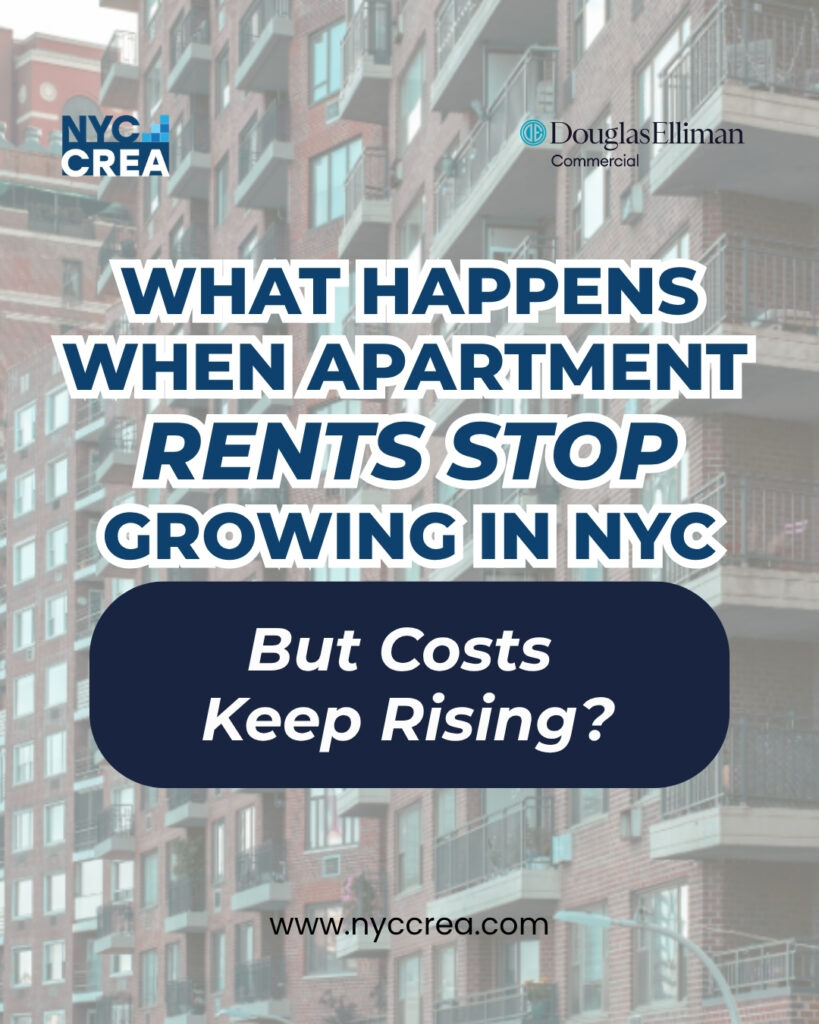
- NYC’s one-year rent freeze runs from October 1, 2026 through September 30, 2027, limiting rent growth for stabilized apartments.
- Stabilized-building operating costs have increased an average of 5.1% annually over the past decade, with insurance costs rising 12.7% per year.
- Credit rating agency Fitch currently views the freeze as neutral for rated US banks, but a longer or broader freeze could increase credit risk, particularly for lenders concentrated in NYC multifamily properties.
What does the NYC rent freeze mean for commercial real estate right now?
From where we sit as NYC commercial real estate brokers, the biggest issue is not simply the rent freeze.
It is the growing gap between property income and property expenses.
The NYC Rent Guidelines Board approved a freeze for rent-stabilized leases covering both one-year and two-year renewals. The policy takes effect October 1, 2026 and runs through September 30, 2027.
For a stabilized multifamily owner, the situation is easy to understand.
Imagine owning a building where rents are essentially flat for the year, but insurance, repairs, labor, utilities, and other operating costs continue climbing.
Revenue stays relatively constrained.
Expenses do not.
That puts pressure on the Net Operating Income, which measures a property’s profitability excluding taxes and financing.
And when NOI comes under pressure, the effects can reach far beyond the property owner. Lenders start watching debt-service coverage. Investors reassess valuations. Buyers become more selective. Refinancing becomes more complicated.
According to CRE Daily, Fitch currently considers the one-year freeze neutral for rated US banks. The concern grows if the policy is extended or expanded because prolonged restrictions could put more pressure on multifamily property cash flow.
For us, that makes the duration of the policy just as important as the policy itself.

How much are NYC multifamily operating costs actually increasing?
1. What happens when rents stay flat but expenses rise 5.1%?
Fitch-cited Rent Guidelines Board data shows that operating costs for stabilized buildings increased by an average of 5.1% annually over the past decade.
That is a major number for CRE owners.
Let’s make it practical.
Suppose a building has $1 million in annual operating expenses.
A 5.1% increase would add approximately $51,000 in expenses in one year if that increase were applied directly.
Now imagine expenses continuing to rise while rental income remains frozen.
That is the squeeze.
The problem becomes even more significant for older buildings that require frequent capital improvements or have higher maintenance requirements.
2. Why is insurance becoming such a major concern?
Insurance is one of the clearest examples of expense pressure.
According to the Fitch data cited by CRE Daily, insurance costs increased an average of 12.7% annually, with double-digit annual increases since 2020.
For a multifamily owner, that can materially change the operating statement.
A property that was already operating on a tight margin can quickly lose NOI when insurance, taxes, repairs, and other expenses increase faster than rental income.
This is why we cannot look at a rent freeze in isolation.
We have to look at the entire property-level income statement.
3. Which NYC multifamily properties are most exposed?
Properties with a high percentage of rent-stabilized units face the greatest sensitivity.
Many of these assets are older buildings, including properties constructed before 1974.
That creates a potentially difficult combination.
Older physical infrastructure plus rising operating expenses plus limited rent growth.
A mixed building can have more flexibility because market-rate units may generate additional income.
That difference matters when we compare two multifamily properties that might appear similar on the surface.
One may have 90% stabilized units.
Another may have a much more diversified rent roll.
The underlying risk is not the same.

How could the rent freeze affect NYC commercial real estate?
1. Could the rent freeze reduce multifamily NOI?
Yes, particularly if operating expenses continue rising.
NOI is essentially the engine behind property valuation and debt capacity.
If revenue remains flat while expenses rise, NOI gets squeezed.
And that can affect everything from investor returns to refinancing.
The historical numbers show why we should pay attention.
NYC rent-stabilized properties experienced positive annual NOI growth historically, but NOI declined 7.8% in 2019 and 9.1% in 2020.
Those declines show that NYC multifamily NOI can fall sharply when operating and market conditions deteriorate.
2. Why does Manhattan appear better positioned?
Location and income growth matter.
According to Fitch, average NOI for core Manhattan increased 10% from 2023 to 2024.
By comparison, NYC excluding core Manhattan recorded a 4.7% increase.
That difference gives some Manhattan properties a larger cushion against rising expenses.
It does not eliminate the risk.
It simply means some assets may have more income growth and stronger fundamentals to absorb cost increases.
For investors, that makes submarket analysis critical.
“NYC multifamily” is not one homogeneous investment category.
A stabilized asset in core Manhattan can have a very different financial profile from an older heavily regulated building in another borough.
3. Could lenders become more cautious?
This is where we think the banking angle becomes important.
Fitch currently views the one-year freeze as neutral for rated US banks.
But banks with significant NYC multifamily exposure could be more sensitive if the policy lasts longer than one year.
If property NOI declines, debt-service coverage ratios can weaken.
If values decline, loan-to-value ratios can deteriorate.
And if a property cannot generate enough cash flow to comfortably service its debt, refinancing risk increases.
That does not mean NYC multifamily lending is suddenly shutting down.
It means lenders have another variable to consider when underwriting the asset.
4. Which banks and lenders are better positioned?
Diversification matters. A large bank with exposure across multiple markets and property types may be better positioned to absorb weaker performance in one segment.
Banks that have already reviewed their portfolios and established provisions for troubled loans may also have more protection.
For lenders, the question becomes less about whether NYC multifamily is risky and more about how concentrated that exposure is.
A bank with 5% exposure to the affected segment is in a different position from one heavily concentrated in rent-regulated NYC multifamily.
5. Could property values come under pressure?
Potentially. Commercial real estate values are heavily influenced by NOI.
If NOI declines and capitalization rates remain unchanged, property value can decline.
For example, if a property generates $1 million in NOI and trades at a 5% cap rate, its implied value is approximately $20 million.
If NOI falls to $900,000 while the cap rate remains 5%, the implied value falls to approximately $18 million.
That is a $2 million difference from a $100,000 change in annual NOI.
This is why a seemingly modest change in operating performance can have a much larger impact on asset value.
What should NYC CRE brokers and investors watch next?
For us, the biggest issue is duration.
A one-year freeze is one thing.
A multi-year freeze is something else entirely.
If rents remain constrained while expenses continue increasing at anything close to historical rates, the pressure on NOI becomes cumulative.
That is where we would start paying closer attention to:
- Rent-stabilized unit concentration
- Historical NOI growth
- Current insurance costs
- Property tax exposure
- Deferred maintenance
- Debt-service coverage
- Loan maturity dates
- Current loan-to-value ratios
- Sponsor liquidity
- Market-rate versus stabilized unit mix
For brokers, this is also a reminder that pricing conversations need to be grounded in property fundamentals.
If an owner wants a certain valuation, we should be able to explain how the property’s current NOI supports it.
If an investor is making an offer below the seller’s expectations, we should understand whether the discount reflects actual income risk, future capital expenditures, financing conditions, or simply a buyer’s return requirements.
For investors, we would stress-test the numbers.
What happens if insurance increases another 10%?
What happens if repairs increase 5%?
What happens if rents remain flat for two years instead of one?
What happens when the loan matures?
Those scenarios can tell us much more than today’s NOI alone.
Is NYC’s rent freeze a major CRE crisis?
Not yet.
At least according to Fitch’s current assessment, the one-year policy is not a material credit event for rated US banks.
But we would not ignore it.
The numbers tell us why.
Operating costs have risen 5.1% annually on average over the past decade. Insurance has risen 12.7% annually. Core Manhattan NOI increased 10% from 2023 to 2024, while the rest of NYC posted a 4.7% increase.
Those differences matter.
For us brokers at NYCCREA, the takeaway is simple.
We should not evaluate a multifamily property based on rent growth alone. We need to understand expense growth, tenant mix, regulation, financing, building condition, and the property’s ability to generate sustainable NOI.
For investors, the opportunity may be in identifying assets where the market is pricing in too much risk or too little risk.
For lenders, concentration and underwriting discipline will matter.
And for everyone watching NYC multifamily, the biggest question is no longer simply “What happens during the one-year freeze?”
It is: What happens if the freeze lasts longer while NYC operating costs keep going up?
That is the scenario that could turn today’s manageable pressure into a much bigger commercial real estate problem.
For more insights and commercial opportunities in New York City and Western Nassau County, follow us.
Andreas Nakos
Licensed Associate Real Estate Broker
917.886.6918
andreas.nakos@elliman.com
Steven Llorens
Licensed Associate Real Estate Broker
917.830.7091
steven.llorens@elliman.com