

September 16, 2026
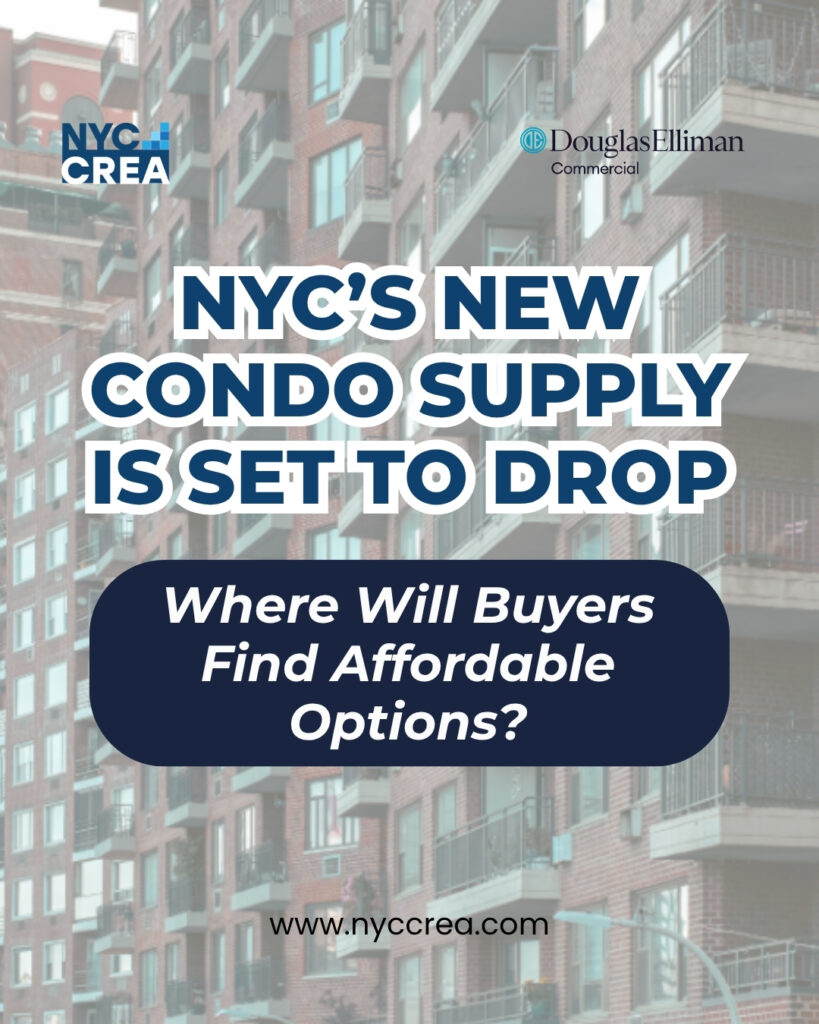
- New condo launches are projected to fall 11% through 2029, averaging about 13,000 new condo and rental units annually across the studied Manhattan, Brooklyn, and Queens markets.
- Entry-level condo supply at $1,800 per SF or less could plunge 74%, while Manhattan has nearly 3,000 luxury units planned at $2,400 per SF or more.
- Rentals will represent about 78% of the 52,000-unit pipeline, while the city estimates it needs roughly 700,000 additional homes over the next decade.
What’s Happening To NYC’s New Condo Supply?
We are looking at a New York City housing pipeline that is becoming increasingly rental-heavy and increasingly concentrated at the luxury end of the condo market.
According to Corcoran Sunshine Marketing Group’s 2026 Pipeline report, new condo launches across Manhattan, Brooklyn, and Queens are projected to decline 11% through 2029. The pipeline is expected to average roughly 13,000 condo and rental units annually, compared with a 13,400-unit average over the past decade.
CRE Daily reports that the total pipeline is expected to include about 52,000 market-rate condo and rental units through 2029. The bigger story for us is not simply the number of units. It is the type of product being delivered.
More of the pipeline is rental housing. Much less is entry-level for-sale housing.
And that distinction matters for developers, investors, brokers, and buyers.

Why Are NYC Entry-Level Condos Getting Scarce?
1. The for-sale pipeline is getting smaller
Manhattan developers have brought fewer than 1,500 new for-sale units to market annually in recent years, while roughly 1,800 units typically sell each year.
That creates a structural supply gap.
The slowdown also goes back to the 2019 changes to New York’s rent laws, which effectively ended many rental-to-condo and co-op conversion opportunities that had historically added for-sale inventory.
For developers, conversion projects have also become more complicated, particularly when occupied rental buildings and litigation risks are involved.
2. Entry-level inventory is disappearing
The numbers are particularly striking at the lower end of the condo market.
Supply priced at $1,800 per SF or less is projected to decline 74% through 2029. In core Manhattan, only about 170 entry-level units are planned.
At the other end, Manhattan has nearly 3,000 units priced at $2,400 per SF or more in the pipeline.
That creates roughly a 17-to-1 gap between planned luxury and entry-level units in the market cited by CRE Daily.
For buyers looking below the $3 million range, that is an important market signal.
3. Why are rentals dominating the pipeline?
About 78% of the roughly 52,000 units expected through 2029 will be rentals.
Nearly 13,000 units are expected to come from office-to-residential conversions in core Manhattan.
The economics explain part of the shift.
Rental projects can provide developers with recurring cash flow, while for-sale projects depend much more heavily on buyer demand, pricing, absorption, financing conditions, and sales velocity.
At the same time, NYC’s multifamily construction pipeline is also slowing.
CRE Daily reported that developers filed plans for just 8,064 new apartments across 172 projects in Q2 2026, down 52% from Q1. Only nine of those 172 projects contained 100 or more units.
That is another sign that developers are adjusting project size and strategy around today’s development economics.
Where Will Condo Buyers Find Affordable Options?
For buyers looking below $1,800 per SF, the choices are getting tighter, so we would expect more attention to shift toward Brooklyn, Queens, emerging neighborhoods, resale condos, and smaller units rather than new luxury developments in core Manhattan.
- Look beyond core Manhattan
With only about 170 entry-level units planned, buyers may increasingly look to Brooklyn, Queens, and emerging neighborhoods for lower-priced options. - Turn to resale condos
As new supply is set to drop, existing condos could become an increasingly important source of more accessible ownership opportunities. - Watch conversions and incentives.
Any policy changes that make rental-to-condo conversions or entry-level development more viable could create new opportunities for buyers and investors.
For buyers, the key takeaway is simple. The search may need to become broader, more flexible, and more focused on total cost as NYC’s pipeline shifts toward rentals and luxury condos.
What Does The Condo Shortage Mean For Commercial Real Estate?
1. Development sites could become more strategic
When new construction becomes harder to pencil, the value of well-positioned development sites can become increasingly dependent on what can actually be built on them.
We would look closely at zoning, permitted density, conversion potential, financing structure, tax incentives, construction costs, and achievable pricing before assuming a site can support a traditional condo strategy.
2. Luxury and entry-level markets could continue to diverge
Nearly 3,000 luxury units versus roughly 170 entry-level units in core Manhattan tells us something important about product mix.
The question is not simply whether NYC is building.
It is what NYC is building and who can afford it.
For investors, that means underwriting demand by price point rather than treating the overall residential market as one category.
3. Rental demand remains central to the CRE equation
With rentals accounting for about 78% of the projected pipeline, multifamily remains a major part of the city’s development story.
That matters for land values, apartment building acquisitions, construction financing, property management, retail demand, neighborhood services, and commercial corridors surrounding new residential projects.
4. Office conversions remain an important CRE opportunity
Nearly 13,000 units in the pipeline are expected from office-to-residential conversions in core Manhattan.
But conversion feasibility is highly property-specific.
We would examine floor plates, light and air requirements, plumbing, structural conditions, zoning, financing, and conversion costs before assuming an office building can easily become residential.
5. NYC’s housing target is much larger than the current pipeline
The city’s Fair Housing Growth Strategy estimates that NYC needs approximately 700,000 new homes over the next decade.
That translates to roughly 70,000 homes per year.
Compare that with a pipeline of about 52,000 market-rate condo and rental units through 2029, and the scale of the challenge becomes much easier to see.
The numbers are not directly equivalent because the 700,000 figure covers the city’s broader housing need while the 52,000 figure covers a specific market-rate pipeline and geography. But the gap still illustrates how much additional production the city is targeting.
What Should NYC CRE Brokers And Investors Watch Next?
We would not look at the 11% condo pipeline decline in isolation.
We would watch product mix, price points, development incentives, conversion activity, construction filings, and absorption together.
The city is pursuing a much larger housing agenda. The Mamdani administration’s Block by Block plan calls for 200,000 new affordable homes over the next decade, while the administration says it financed more than 12,000 affordable homes during the first six months of 2026.
At the same time, CRE Daily’s reporting shows that private multifamily development is facing a different set of economics, with Q2 filings falling sharply and developers concentrating on smaller projects.
For us as CRE brokers, that means the opportunity is in understanding the property-level story behind the headline.
Is the site better suited for rental, condo, mixed-use, or conversion?
What price point can the market actually absorb?
What incentives are available?
What does the zoning allow today versus what could be achieved through a future change?
And how does the development timeline affect the investment market?
For investors, those questions can be more useful than simply asking whether NYC housing supply is going up or down.
The numbers point to a market where new housing is still coming, but the mix is changing. More rentals, fewer entry-level condos, a substantial luxury pipeline, and continued pressure to increase overall housing production will keep shaping NYC commercial real estate through 2029.
For CRE brokers and investors, knowing exactly what is being built, where it is being built, and who can afford it will be critical to understanding the next phase of the New York City market.
For more insights and commercial opportunities in New York City and Western Nassau County, follow us.
Andreas Nakos
Licensed Associate Real Estate Broker
917.886.6918
andreas.nakos@elliman.com
Steven Llorens
Licensed Associate Real Estate Broker
917.830.7091
steven.llorens@elliman.com