

3 Quick Highlights
- Environmental reviews in New York currently average 2.5 years, often making projects more expensive before construction even begins.
- Major projects can take more than 50% longer in New York than in peer states, creating major pressure on affordability and delivery timelines.
- The Let Them Build agenda is gaining support from city, housing, and environmental leaders across the state, signaling serious momentum behind regulatory reform.
Why This Matters Right Now
As brokers working across New York commercial real estate, we at NYCCREA see the same frustration repeatedly: projects that should move in months often take years because approvals, reviews, and procedural layers create uncertainty long before financing, leasing, or construction even begins.
For developers, every delay means carrying costs rise. For municipalities, needed housing and infrastructure arrive too late. For investors, timelines become difficult to underwrite with confidence. And for communities already facing affordability pressure, delayed construction means fewer units, higher rents, and slower economic growth.
Governor Kathy Hochul’s Let Them Build Agenda is positioned as a direct answer to that problem: reduce unnecessary delay without removing local zoning authority or environmental protections.

What the Let Them Build Agenda Actually Includes
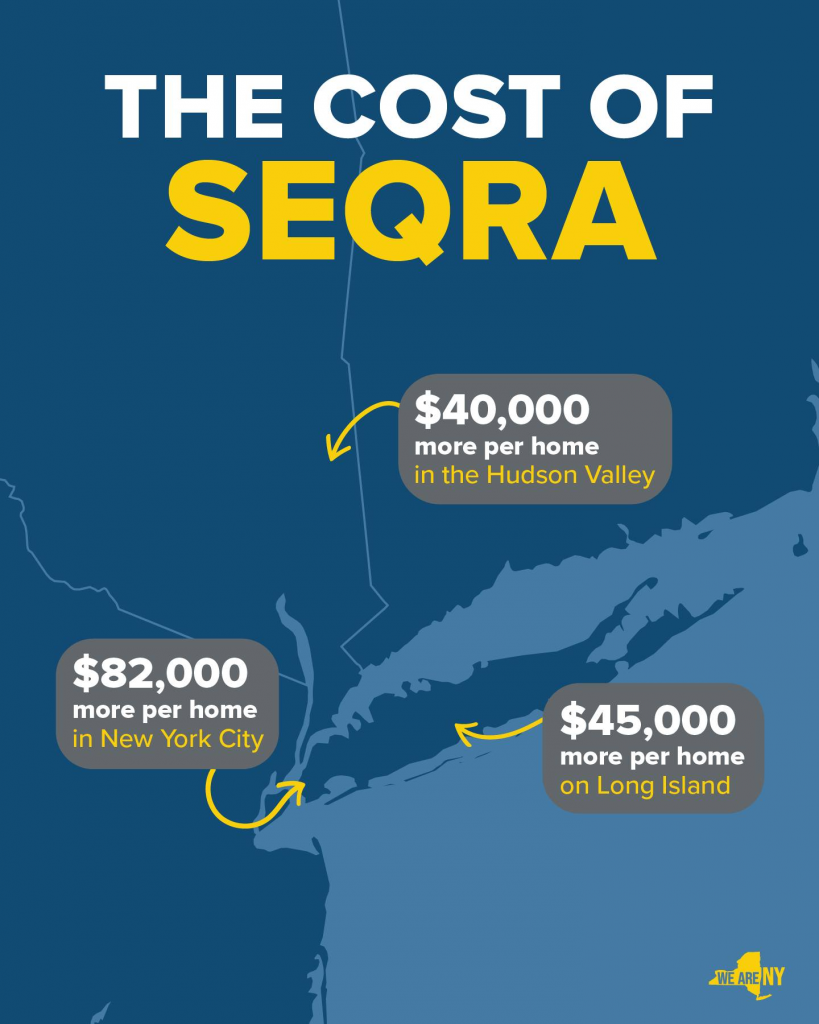
From our analysis of the proposal, the agenda is highly focused on modernizing how projects move through New York’s approval system, especially under the State Environmental Quality Review Act (SEQRA).
1. Clearer Environmental Review Timelines
The state wants environmental reviews for eligible housing and infrastructure projects to move under more predictable deadlines instead of open-ended procedural delays. That matters because today reviews average 2.5 years.
2. Faster Approval for Low-Risk Projects
Projects that consistently show little or no adverse environmental impact may qualify for faster treatment, especially where zoning already supports development.
3. Standardized Review Procedures
The proposal aims to reduce inconsistency between municipalities by simplifying and clarifying review pathways so applicants know earlier what is required.
4. Lower Cost Through Reduced Delay
When approvals move faster, predevelopment carrying costs, consultant fees, and financing exposure all decline especially important for multifamily and mixed-use projects.
5. Focus Beyond Housing
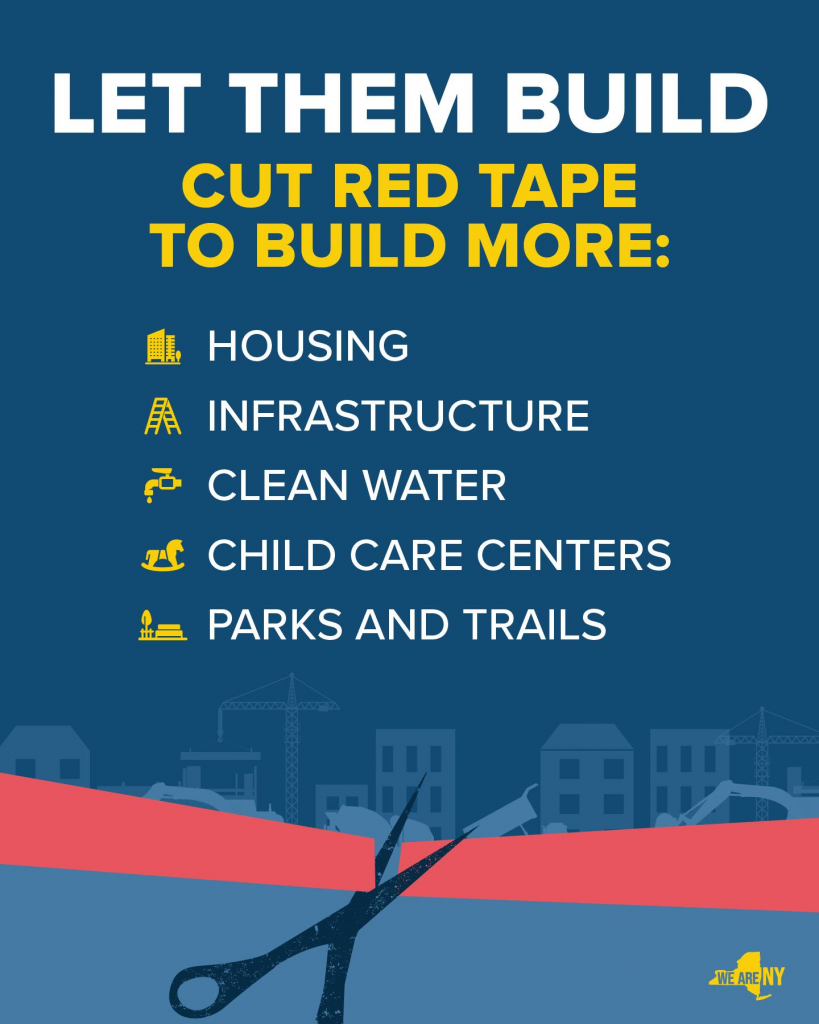
The agenda does not only target residential supply. It also includes:
- child care centers
- clean energy projects
- municipal infrastructure
- transportation improvements
These categories are specifically identified as critical development priorities.
In short, the Let Them Build Agenda would speed up housing delivery in New York by exempting certain low-impact, locally approved housing projects from additional SEQRA review, setting clearer review deadlines, and simplifying environmental approvals without removing local zoning control. It also creates faster pathways for infrastructure and housing projects, especially in New York City where project size caps will determine which developments can avoid lengthy extra review. This helps reduce construction delays, lower costs, and bring more housing and commercial infrastructures to market faster.
Who Is Supporting It Across New York
What stands out is that support is coming from multiple sectors, not just state leadership.
- NYC Mayor Zohran Mamdani said the city cannot solve its housing crisis without making housing easier to build and called environmental review reform necessary for affordability delivery.
- New York State Homes and Community Renewal Commissioner RuthAnne Visnauskas emphasized that reforms could reduce time to groundbreaking by more than 50 percent while preserving environmental protections.
- Empire State Development President Hope Knight highlighted the importance of accountable timelines for housing, clean energy, and infrastructure investment.
- Marc Herbst, Executive Director of Long Island Contractors’ Association, said contractors across Long Island support modernizing SEQRA because faster review for low-impact projects would help deliver essential infrastructure, create local jobs, and maintain strong environmental protections.
This broad support from public and private organizations matters because major regulatory reform often fails when agencies disagree on implementation. Leaders are calling the move a restoration of faith that the government can deliver faster construction, clear development logjams, and create incentives for sustainable housing.

Potential Impact on Commercial Real Estate in New York
From a brokerage perspective, this could materially change how certain asset classes move, specifically in multifamily and mixed-use properties.
1. Multifamily Development Could Become More Financeable
Shorter review periods improve lender confidence because entitlement uncertainty often drives financing hesitation.
2. Mixed-Use Sites May Gain New Value
Sites that already fit local zoning but face procedural delays could become more attractive acquisition targets.
3. Land Pricing Could Shift
If entitlement becomes more predictable, land previously discounted for timing risk may reprice upward.
4. Infrastructure-Led CRE Corridors Could Accelerate
Faster transportation and municipal projects often trigger adjacent retail, office, industrial, and housing demand.
5. Adaptive Reuse May Benefit Indirectly
Clearer review pathways may help owners convert underperforming assets faster where municipal support exists.
2026 As A Major Reform Year
We believe the biggest market effect will not come from one law change alone. It will come from certainty.
Developers can tolerate regulation. What slows transactions most is unpredictable duration.
If the state’s Let Them Build Agenda succeeds in giving municipalities clearer decision windows, we expect:
- More aggressive land positioning
- Stronger pipeline confidence
- Earlier capital deployment
- Increased attention to outer-borough and suburban redevelopment opportunities.
The practical guidance for owners, developers, and investors right now is simple:
Watch Which Municipalities Move First
Some jurisdictions will adapt faster than others.
Re-Evaluate Delayed Sites
Properties previously considered difficult may become newly viable.
Prepare for Faster Competition
If approvals compress, buyer competition for development-ready sites may intensify quickly.
New York has long had strong demand but slow delivery. In New York City alone, office demand continues its upward trend, with Manhattan posting the Northeast’s highest average listing rate at more than $73 per square foot and recording over $1.6 billion in office sales, which is the highest in the nation since the start of the year. NYC’s office space pipeline is the second-largest in the Northeast region after Boston early this year. Its more than 2.7 million square feet of office space under construction shows the huge potential for government-led efficiency in delivery.
Across the state, housing demand remains intense as inventory fell to just 22,366 homes in February, the lowest level ever recorded since tracking began in 1997, according to the New York State Association of REALTORS®. Limited supply continues to pressure buyers statewide. With available listings down 3.9% year over year, demand is still outpacing new housing delivery across many markets.
The Let Them Build Agenda attempts to change that by attacking one of the market’s oldest bottlenecks: delay before construction even begins.
For commercial real estate, faster process does not just mean faster buildings. It means faster decisions, faster capital movement, and potentially a very different competitive landscape over the next few years.
If implementation matches the ambition, this could become one of the most meaningful structural changes to New York development timing in years.
For the latest news, proven strategies, and exclusive opportunities in commercial real estate in New York City and Western Nassau County NY, visit us at www.nyccrea.com
FOLLOW US:
Facebook: www.facebook.com/newyorkcityCREA
Instagram: www.instagram.com/nyccrea
LinkedIn: www.linkedin.com/company/nyccrea